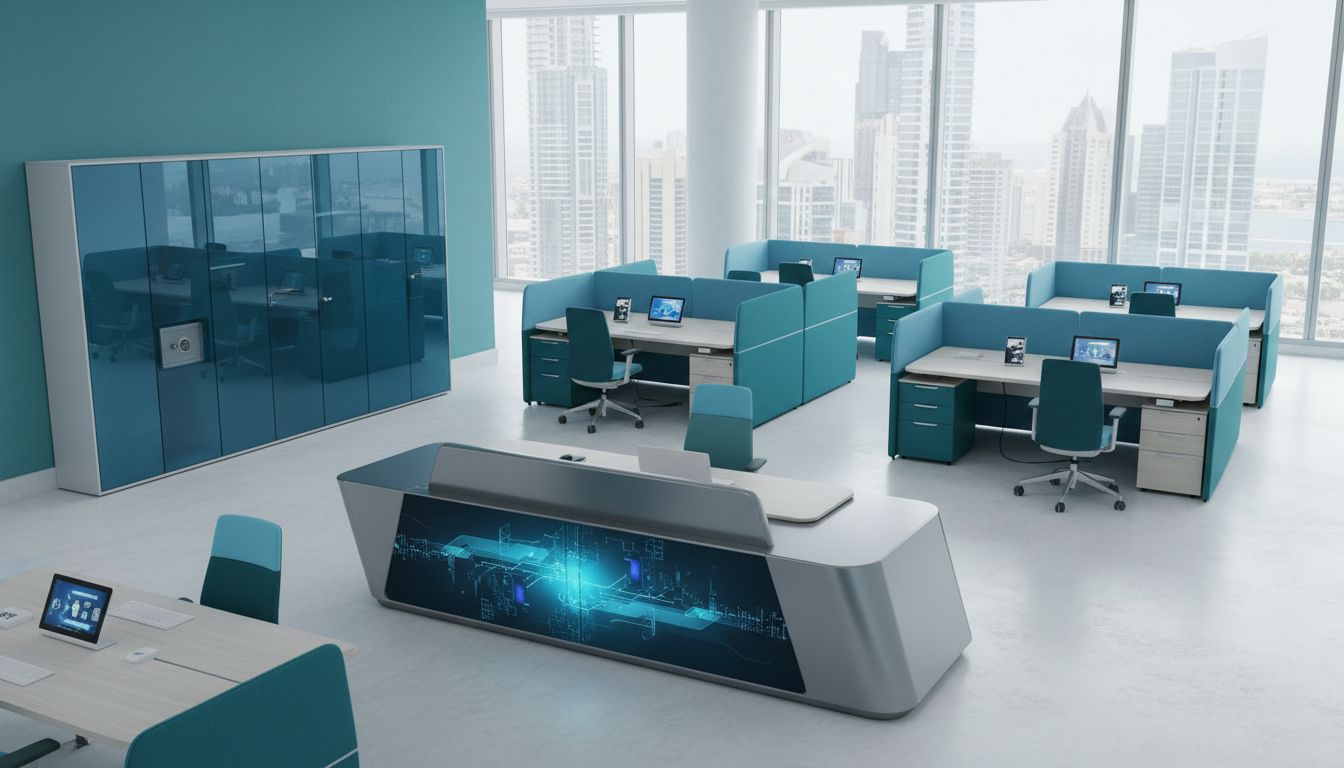
Dubai’s office market is giving workplace decision-makers a clear signal: every square metre has to work harder. By the end of December 2025, CBRE reported average office occupancy in Dubai at nearly 95%, up from 93% a year earlier, while average office rents rose 18% year on year and prime rents increased 23%. In high-demand zones such as DIFC, d3, TECOM, and DMCC, occupiers are facing growing difficulty in finding suitable alternatives, which is pushing more businesses to rethink interiors not as fixed fit-outs, but as flexible assets that can adapt quickly.
At the same time, hybrid work is changing what companies need from the office. The question is no longer whether teams will split time between home, client sites, and quarters, but how workplace interiors can support that rhythm without wasting space or compromising employee experience. In Dubai, that answer is increasingly taking the form of modular, tech-integrated interiors built for agility, collaboration, and operational efficiency.
The market pressure behind modular workplace design
One of the strongest drivers of modular office planning in Dubai is simple market pressure. According to The National, Grade A occupancy in prime districts such as DIFC, Downtown Dubai, and Business Bay was nearing 97% in the first half of 2024, even as the city continued to attract new companies. The same report noted that the return to office has been happening with greater flexibility in lease terms and layouts, showing that occupiers are not abandoning physical offices, but they are becoming more selective about how those offices perform.
Arabian Business, citing Savills data, added that office rental prices across 22 Dubai sub-markets rose 45% year on year in Q1 2025, with DIFC occupancy reaching 98%. It also reported a 4.9% increase in net effective occupier costs, including base rent, fit-out expenses, and related costs, with Dubai ranking eighth globally for total prime office occupancy costs at $148.9 per sq ft per annum. When space becomes this valuable, rigid floorplans become harder to justify.
For office managers and procurement teams, modular interiors offer a practical response. Demountable partitions, mobile storage, adaptable workstations, and furniture systems that can be reconfigured help organizations avoid costly churn. Instead of fitting out for one fixed count or one working style, businesses can create interiors that flex between focused work, team collaboration, and client-facing functions as needs change.
Why hybrid teams need interiors that can shift by the day
Hybrid work has made office utilization less predictable, and that variability is one reason modular interiors are gaining traction. On some days, a workplace may need more touchdown desks and quiet zones for individual work. On others, it may need project tables, collaboration rooms, and presentation areas for larger in-person gatherings. A fixed layout struggles to keep up with those fluctuations, especially in high-cost markets like Dubai.
Global guidance aligns closely with what is now happening locally. McKinsey’s hybrid-work assessment framework describes effective offices as highly modular and movable, with technology integrated seamlessly to support the right balance between in-person and remote work. That principle is increasingly visible in Dubai workplaces, where flexibility is being designed into both furniture selection and spatial planning from the start.
This approach also reduces the risk of underused real estate. Instead of assigning large areas to permanently dedicated functions, hybrid-ready offices are creating spaces that can change role throughout the day. A lounge can become an informal meeting zone, a training room can convert into a town-hall setting, and a bank of shared desks can support rotating teams without expanding the overall footprint.
Coworking and serviced office growth is influencing mainstream fit-outs
Dubai’s expanding flexible workspace sector is having a wider effect on how conventional offices are designed. The National reported that many UAE businesses now prioritize flexible workspaces aligned with hybrid work models, supporting growth among operators such as The Executive Centre, Cloud Spaces, Servcorp, IWG, and WeWork. These environments have normalized the idea that offices should offer a mix of solo, team, hospitality, and client functions within one adaptable setting.
That shift is also visible in district-level offerings. DMCC actively promotes premium offices, serviced desks, shared spaces, and coworking options with flexible layouts and high-quality finishes, reflecting how workspace as a service is becoming more accepted in Dubai. Rather than expecting every business to commit to a traditional, static office model, major commercial hubs are packaging workplace flexibility as a core product.
TECOM’s D/Quarters concept is another strong example. The company said its expansion at Dubai Science Park was driven by rising demand for future-focused, adaptive workspace solutions that support flexibility and collaboration. With open coworking spaces, hot desking, dedicated desks, meeting rooms, move-in-ready offices, and private offices, the format reflects the mixed-use workplace typologies that many hybrid teams now expect, whether they occupy a serviced office or a custom-fit corporate floor.
The rise of plug-and-play, tech-integrated interiors
Hybrid teams do not only need flexible furniture; they also need workplaces that are digitally coordinated. In Dubai, smart office technologies are increasingly supporting this shift. Siemens’ UAE deployment of Comfy and Enlighted provided a concrete example of how employees can find and book desks and meeting rooms through sensor-enabled systems, creating a more efficient and visible model of space use.
More recently, Johnson Controls launched OpenBlue Workplace in the Middle East in June 2025, positioning it as a platform for reporting, analytics, and integration with smart building technologies. For occupiers in Dubai, this kind of system supports real-time desk management, room scheduling, utilization tracking, and data-led decisions about future space allocation. In a modular office, that information becomes especially valuable because layouts can be adjusted in response to actual usage patterns rather than assumptions.
The design implication is significant. Modular interiors work best when paired with technology that helps teams navigate and use them effectively. Power access, integrated booking displays, wireless collaboration tools, occupancy sensors, and app-based workplace management are turning the office into a responsive environment. Instead of simply looking modern, these interiors actively help hybrid teams coordinate where and how they work.
Meeting rooms are becoming smarter, smaller, and more inclusive
One of the clearest changes in Dubai offices is the evolution of meeting spaces. Traditional boardrooms designed mainly for in-person attendance are giving way to a wider mix of huddle rooms, project rooms, video-enabled focus booths, and reconfigurable collaboration areas. This reflects the reality that meetings now need to serve both onsite participants and remote colleagues without creating an uneven experience.
Technology launches tied to Dubai’s innovation ecosystem reinforce this direction. At GITEX Global 2024, PFU, a Ricoh company, launched the RICOH 360 Meeting Hub in the Middle East, promoting it as a tool for more inclusive and immersive hybrid meetings. A of GITEX Global 2025 in Dubai, Logitech also highlighted AI-enabled collaboration products designed to help workspaces better support employees whether they are in the office or remote.
For workplace planners, this means meeting areas can no longer be treated as one-format rooms. Interiors increasingly need modular tables, movable seating, acoustic treatment, integrated cameras, microphones, display systems, and lighting suitable for video communication. The goal is not just to equip a room with technology, but to design every collaboration space around visibility, flexibility, and equitable participation.
Space efficiency is driving multi-use zones and modular furniture choices
As occupier costs rise, multi-functionality is becoming a central principle of office design in Dubai. Businesses want fewer dead zones and more spaces that can support multiple tasks throughout the week. A reception area may double as a waiting lounge and informal meeting point. A café setting may host team check-ins, workshops, or client conversations. Shared amenities are being planned as active contributors to workplace performance rather than decorative extras.
Furniture plays a critical role in this transition. Modular benching, foldable or nesting tables, mobile whiteboards, movable acoustic screens, and task seating that can shift between settings make it easier to repurpose space quickly. These solutions are especially valuable for hybrid teams with variable attendance patterns, because they allow the workplace to expand or contract around actual demand.
Recent Dubai projects show how this is being applied in practice. Commercial Interior Design reported in November 2025 that Muse Interior Design’s office project for Eqvilent used modular furniture and flexible layouts so the workplace could evolve with company growth. The same project incorporated acoustic privacy features along with wellness and recreation elements, highlighting how modularity today is not only about fitting more people into a floorplate, but also about balancing adaptability with comfort and performance.
Sustainability and wellness are strengthening the case for adaptable interiors
In Dubai, sustainable office demand is increasingly linked to workplace quality and employee experience. The National reported that many businesses are actively seeking offices with green certifications, energy-efficient systems, and wellness amenities. This matters because modular interiors can support those goals by reducing refurbishment waste, extending product life cycles, and limiting the need for repeated full-scale fit-out changes as teams evolve.
TECOM’s leasing data supports the broader market direction. The group said 55% of its office buildings across Dubai had achieved LEED certification by the first half of 2025, while occupancy across its commercial and industrial portfolio reached 95%, up 3% year on year. This suggests that tenants are increasingly drawn to higher-quality, more sustainable environments, particularly when those spaces also support operational flexibility.
Wellness is becoming part of the same conversation. Hybrid-ready offices are placing greater emphasis on acoustic comfort, air quality, natural light, quiet retreat spaces, and amenity zones that improve the daily experience of coming to work. When designed thoughtfully, modular interiors can support wellness by enabling a better balance of open collaboration and privacy, rather than forcing all employees into a one-size-fits-all layout.
What Dubai occupiers should prioritize when planning for hybrid teams
For organizations reviewing a new fit-out or workplace refresh, the first priority should be adaptability at the planning stage. That means thinking in terms of settings rather than departments alone: quiet focus areas, touchdown points, enclosed rooms for calls, collaborative tables, flexible meeting rooms, and hospitality-style zones for informal interaction. In a tight market, the best-performing offices are often those that can shift between these uses with minimal disruption.
The second priority is integrating technology into the physical environment from the beginning. Desk booking, room scheduling, occupancy analytics, power access, video conferencing, and smart controls should not be treated as separate add-ons. When these systems are coordinated with furniture layouts and circulation planning, the office becomes much easier to manage and more intuitive for employees to use.
Third, occupiers should evaluate modularity through a lifecycle lens rather than only initial cost. In Dubai’s current market, where rents, fit-out costs, and occupancy pressure remain elevated, the ability to reconfigure instead of rebuild can deliver meaningful long-term value. For business owners, designers, and procurement professionals, the result is a workplace that stays aligned with growth, changing work patterns, and evolving employee expectations.
Dubai’s workplaces are not moving toward modular, tech-integrated interiors as a design trend alone. They are doing so because market conditions, occupier costs, hybrid work patterns, and employee expectations are all pointing in the same direction. With office availability tight in prime districts and companies seeking flexible, well-connected, high-specification environments, adaptable interior planning is becoming a practical business strategy.
For occupiers across DIFC, Business Bay, TECOM, DMCC, and beyond, the most resilient office is increasingly one that can be reconfigured, measured, and upgraded over time. Modular workplace design, supported by integrated technology and a focus on sustainability and wellness, gives hybrid teams the flexibility they need today while helping organizations protect value in a fast-moving Dubai office market.