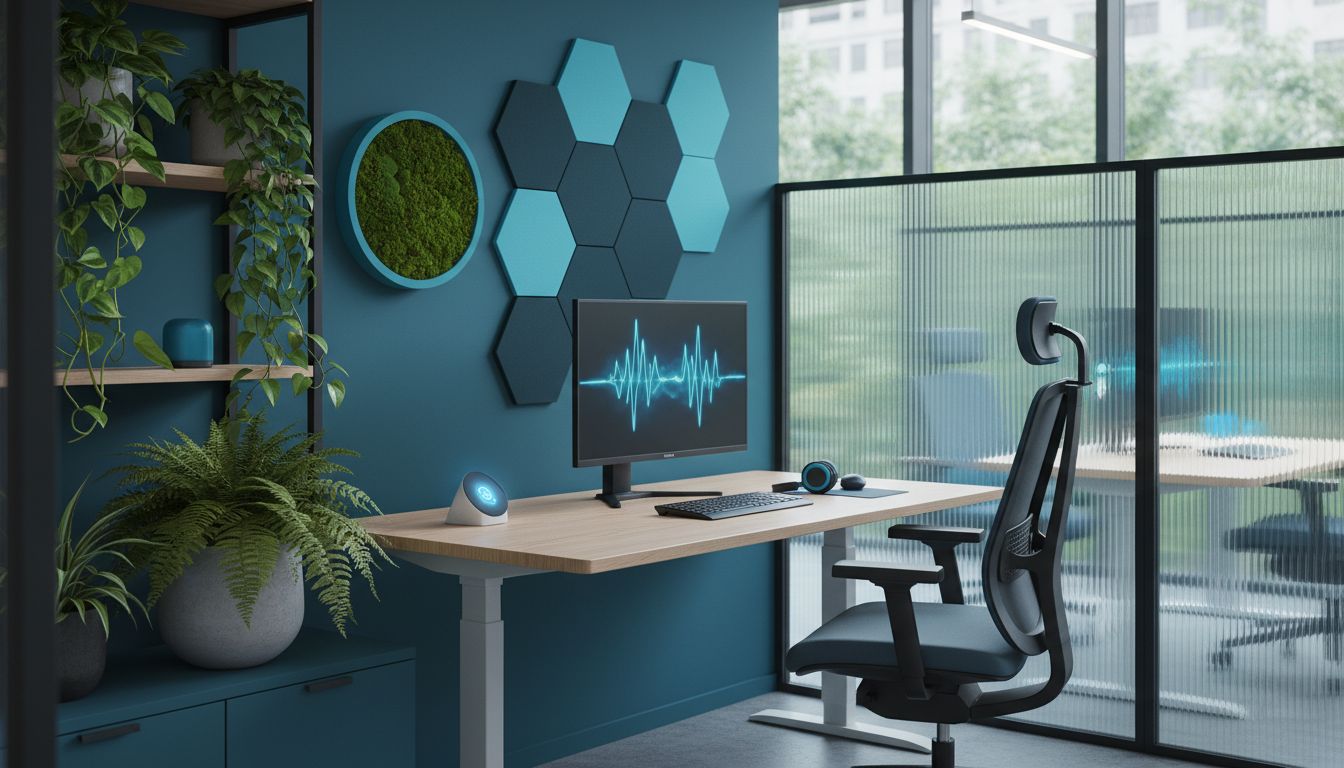
The hybrid office has changed what employees need from the workplace. Rather than serving only as a place for attendance, the office now has to support different work modes across the day, from deep concentration and virtual meetings to team workshops and informal connection. Recent insights from CBRE’s 2026 workplace outlook show that hybrid-office design is no longer a simple layout decision. It now sits at the intersection of employee experience, leadership alignment, AI-driven space optimization, and future-ready real estate operations.
For office managers, business owners, procurement teams, and designers, this shift creates a clear design question: how can the workplace actively protect focus while remaining flexible and collaborative? Increasingly, the answer lies in combining artificial intelligence, acoustics, and biophilia into one human-centered strategy. Together, these elements help create offices that are quieter, more adaptive, and better suited to the realities of hybrid work.
Why focus has become a design priority in the hybrid office
Hybrid work is now widely understood as a lasting model rather than a temporary adjustment. A 2025 Haworth global study describes hybrid work as “here to stay,” while Worktech Academy’s 2026 World of Work report connects hybrid work, AI, and biophilia as key forces shaping new workplace routines and collaboration patterns. This means focus can no longer be treated as an individual responsibility alone. It must be supported by the physical environment.
Occupancy data also helps explain the change. VergeSense’s 2025 workplace-occupancy index reports that hybrid and virtual collaboration are now integral to the workday, with fewer people in the office at the same time. As a result, office space is being planned less around permanent desks and more around varied activities. This is one reason activity-based zoning has become such an important response in recent 2026 workplace design commentary.
In practice, designing for focus means creating a workplace that recognizes different cognitive demands. Some tasks require silence and privacy, while others benefit from easy interaction and shared energy. A focus-supportive hybrid office does not try to make every area do everything. Instead, it separates quiet rooms, collaborative zones, hybrid meeting spaces, and retreat areas so employees can choose the environment that best matches the task.
How artificial intelligence supports focus-friendly workplaces
Artificial intelligence is becoming an active part of workplace design rather than a background technology. According to a 2026 office-design trend report from DLR Group, sensor-rich buildings can now adjust lighting, airflow, and sound in response to occupancy. In a hybrid office, this makes AI especially useful because demand on space changes constantly throughout the week and even throughout the day.
CBRE’s 2026 workplace outlook identifies AI-driven space optimization as one of the four major dimensions of workplace strategy. For employers, this means using occupancy and utilization data to understand which spaces truly support focused work, which rooms are underused, and where bottlenecks are creating distraction. AI can help organizations make better decisions about room mix, seating ratios, booking systems, and environmental settings without relying only on assumptions.
There is also a growing connection between AI and user comfort. Recent market language increasingly treats AI, acoustics, and biophilia as part of one integrated approach to comfort, focus, and adaptability. A responsive office might automatically moderate background noise, adjust lighting levels for lower visual fatigue, or improve airflow in rooms with high occupancy. Used well, artificial intelligence helps the workplace become more supportive without becoming more complicated for employees.
The acoustic case for better concentration
Acoustics remain one of the most important and most persistent challenges in hybrid office design. Haworth’s 2025 research specifically points to acoustic problems as part of the workplace response needed for hybrid work. This is not surprising, as many offices now have a mix of phone calls, video meetings, team discussions, and independent work happening at the same time.
WELL’s guidance on sound masking makes the design objective clear: reduce acoustic disruptions and increase speech privacy through building design. In a focus-oriented office, this can include sound-absorbing materials, enclosed rooms for calls, quieter retreat spaces, and sound masking systems where appropriate. The goal is not absolute silence everywhere, but a better match between sound conditions and the activities taking place in each area.
Research also continues to support innovation in this field. A 2025 Nature research summary notes that recent workplace-design studies include acoustic-material optimization models aimed at improving office auditory environments. Alongside this, Office Principles’ 2026 trend roundup highlights acoustic excellence and neurodiversity support as core priorities. That is especially relevant in hybrid workplaces, where sensitivity to noise can significantly affect comfort, concentration, and overall performance.
Biophilia as a practical tool for focus and wellbeing
Biophilic design is often discussed in terms of workplace wellbeing, but its role in supporting concentration is equally important. Interface’s widely cited Human Spaces research continues to be referenced for showing approximately 15% higher wellbeing and creativity, as well as 6% higher productivity, in biophilic workplaces. For organizations seeking a better employee experience, these findings help explain why natural elements remain central to office design strategy.
More recent evidence strengthens the case. A 2025 Scientific Reports study found that a living-wall biophilic intervention reduced stress during a cognitively demanding task when compared with an object-filled shelf. This is a valuable insight for hybrid office planning because it suggests that nature elements may directly help employees maintain focus under pressure, not just improve the look of the space.
Another 2025 Scientific Reports paper on timber-rich workplaces found that biophilic materials were associated with better perceived productivity and health, while also noting that the evidence base still has methodological limits. A 2024 Scientific Reports study similarly found that open-office workers exposed to more natural elements showed better wellbeing outcomes, while taking care to isolate workplace-type effects. Taken together, these findings support a practical conclusion: biophilia can play a meaningful role in focus-supportive workplace design when applied thoughtfully.
Bringing AI and biophilia together
One of the most interesting developments in office design is the way artificial intelligence is beginning to support biophilic thinking. A 2025 Nature paper used visual AI to measure biophilia perceptions across global biomes, showing that machine learning can help quantify nature-based design signals. While this type of research is still developing, it points toward a future in which designers can assess how strongly a workplace communicates calm, restoration, and connection to nature.
In practical terms, this could influence material selection, interior planting strategies, and the placement of visual nature cues throughout the office. AI may help organizations understand which settings feel most restorative, how daylight and planting interact with occupancy patterns, and where biophilic features are likely to have the greatest impact. For procurement and facilities teams, that creates more measurable ways to invest in workplace improvements.
This does not mean replacing human judgment with technology. Instead, it means giving decision-makers better tools to evaluate what supports attention and comfort. When AI insights are paired with natural materials, planting, daylight access, and restorative retreat areas, the result is a workplace that is not only smarter but also more humane.
Activity-based zoning as the spatial framework
Across 2026 workplace design commentary, activity-based zoning is repeatedly presented as the main spatial answer to hybrid work. This approach recognizes that a single open-plan floor cannot effectively support every task. Instead, the office is divided into areas designed for distinct functions, such as focus rooms, quiet corners, collaboration zones, informal lounges, and hybrid meeting rooms.
This approach aligns closely with current occupancy patterns. Since fewer employees are present at the same time, organizations have an opportunity to optimize space around purpose rather than density. VergeSense data reinforces this shift toward flexible planning, and CBRE’s outlook supports a broader operational model in which space is continuously refined using workplace data. For many organizations, this means fewer assigned desks and more intentional environments.
Activity-based zoning also provides the structure needed to combine acoustics, AI, and biophilia effectively. Quiet zones can incorporate higher acoustic control, softer materials, and calming natural elements. Collaboration zones can allow for more energy and interaction without disrupting concentration elsewhere. Hybrid meeting rooms can be planned with better speech privacy and technology integration. In this way, zoning becomes the bridge between strategy and daily experience.
Designing for shared time, retreat, and neurodiversity
A growing of 2026 design commentary suggests that the office is moving away from simple presence and toward intentionally designed shared time. IBA Forum describes this as a shift in which retreat spaces, biophilic elements, and hospitality-driven logic become more important. In other words, the office succeeds when it offers something purposeful that employees cannot easily replicate elsewhere.
This matters for focus because not every productive moment is social. Employees also need places to decompress, reset, and work without interruption. Retreat spaces, enclosed booths, and low-stimulation corners can help people manage mentally demanding tasks and move between collaboration and concentration more smoothly. These features are especially valuable in workplaces designed to support neurodiversity, where sensitivity to noise, movement, and visual stimulation can vary widely.
Office Principles’ 2026 trend roundup highlights neurodiversity support alongside AI integration and acoustic excellence, reinforcing the need for a more inclusive design lens. For specifiers and workplace decision-makers, that means selecting furniture, finishes, and layouts that give users more control over their experience. A well-designed hybrid office does not assume one ideal environment. It offers choices that help different people do their best work.
Designing for focus in the hybrid office is no longer about adding a few quiet rooms or decorative plants. The latest workplace research and trend reporting point to a more connected strategy, where artificial intelligence, acoustics, and biophilia work together to create adaptable and restorative environments. Nature cues, quieter zones, and responsive conditions all contribute to reducing stress and protecting concentration during cognitively demanding work.
For organizations planning future workplace investments, the opportunity is clear. By combining data-led space optimization with strong acoustic planning, biophilic elements, and activity-based zoning, businesses can build offices that are better aligned with how people actually work today. The result is a hybrid office that supports focus not by accident, but by design.